Gravitational Waves
A collaboration between a class of P6 learners at Blackfriars Primary, space scientists from University of Glasgow and Science Ceilidh exploring space science and gravitational waves through movement and play.
On 11 February 2016, scientists around the world announced the first-ever detection of gravitational waves.
Ten years on, we’re celebrating that moment in a very Science Ceilidh way.
In 2025, we collaborated with gravitational wave scientists Andrew Spencer and Christopher Berry from the University of Glasgow to co-create a ceilidh dance inspired by the motion of merging black holes, translating cutting-edge physics into movement, rhythm and culture.
In 2026, that journey continued.

GIF of the Glaswegian Spin of the Blackhole dance, created in 2025
Through our interdisciplinary project with P6 learners at Blackfriars Primary School, young people explored gravitational waves through embodied learning, using Scottish ceilidh and cross-cultural dance traditions to decode complex ideas about spacetime.
Similar to the Star Dust ceilidh dance explaining how stars form, the learners created their own ceilidh dance showing their understanding of gravitational wave formation and detection. This dance was shared with the wider Gorbals community and beyond.
P6 learners conduct an experiment to find out if mass impacts how quickly object fall due to gravity.
Over eight sessions, the learners:
Worked alongside researchers,
Reinterpreted existing gravitational wave dances,
Created their own complementary ceilidh dance,
Became Science Ambassadors at the Gorbals Fair and
Developed educational resources for other young people, including a podcast, written resource and a video!
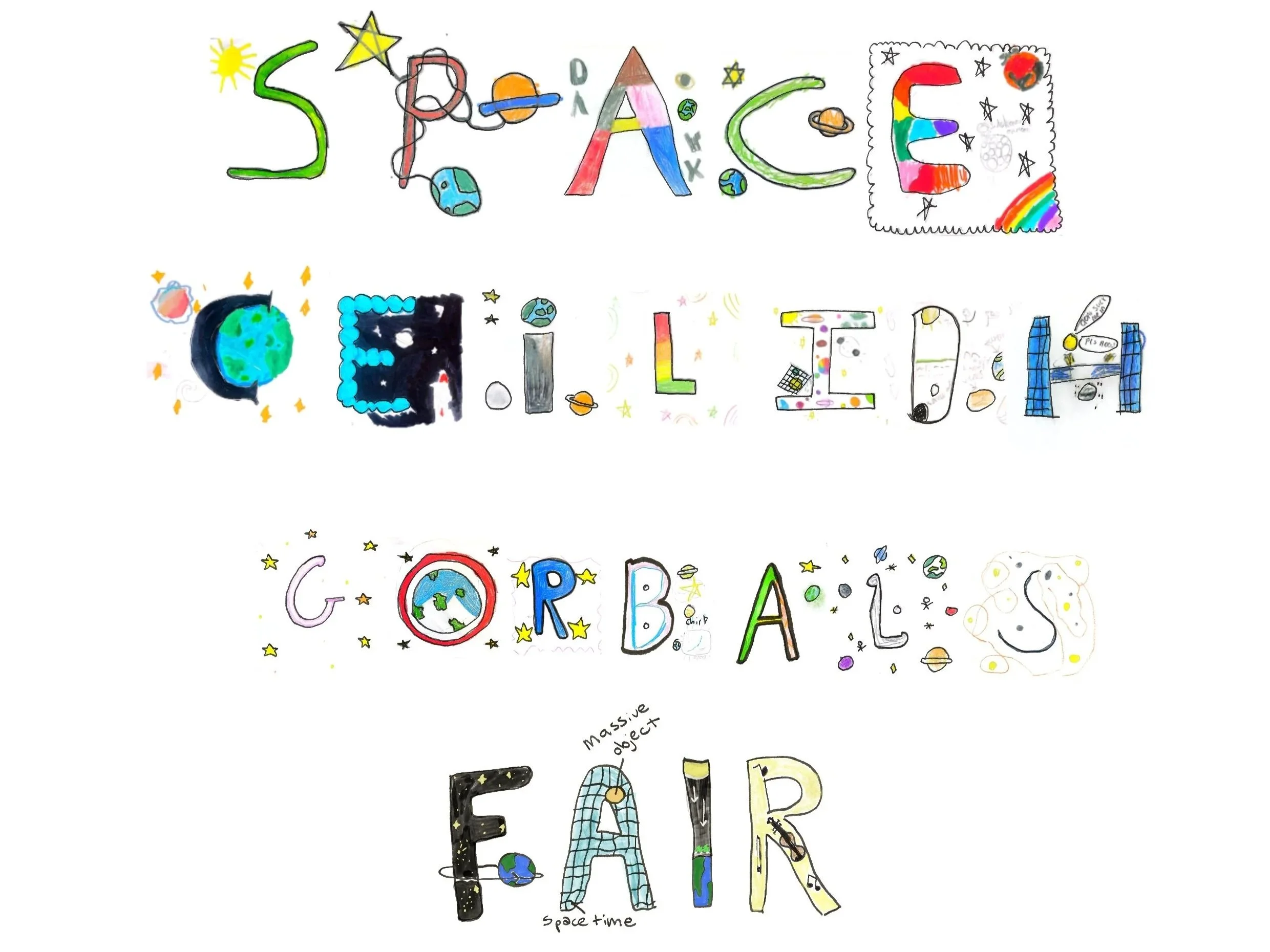
During the Gorbals Fair on Saturday June 6, 2026 the young people hosted a stall and ceilidh to share their learnings about space science!
Funded by Institute of Physics Scotland and Science and Technology Facilities Council, this project builds on the STEM in the Gorbals initiative and shows what happens when physics meets culture, creativity and community.
find out more
-
In Gravitational Waves sessions, we explore these five elements of gravitational waves:
Space and time are joined together into a single, invisible fabric that fills the entire universe.
Anything with mass bends and curves the fabric of spacetime around it.
Gravity happens because objects naturally follow the curves in spacetime created by mass.
When massive objects move or collide quickly, they send energy through the fabric of spacetime.
This energy travels away from the objects as ripples that change the shape of space itself.
We detect these waves by measuring how they slightly stretch and squeeze the distance between two points on Earth.
-
Hands-on and embodied learning is often more fun and more engaging for young learners exploring challenging concepts such as space-time.
Allowing space for sessions with young learners to shift according to the energy and interests of the group can be hugely helpful.
Space science can be an engaging approach to interdisciplinary science exploration with young learners.
Young people hosted the Gravitational Waves stall at the Gorbals Fair. Here, one young scientist explains how mass bends spacetime to create gravity, which is what causes planets to orbit the sun.